
Buzzwole's Legacy: How Pokemon Unite's First Ultra Beast Redefined Close-Quarters Combat
In the ever-shifting landscape of Pokemon Unite’s fifth anniversary year, trainers often look back at the arrival of certain Pokémon as watershed moments. Few debuts in Aeos Island history landed with the seismic force of Buzzwole, the Ultra Beast that stomped into the arena on August 3, 2022. Even in 2026, the Swollen Pokémon’s silhouette on the loading screen can tilt a draft lobby into hushed recalculation, a testament to how a single addition can crystallize an entire playstyle. Buzzwole was not merely another fighter; it was like a smith suddenly dropping a hydraulic press onto a table of delicate clockwork gears, forcing every other melee contender to redesign their internal mechanics or risk being flattened.
When the Bug/Fighting-type first tore through the fabric of Remoat Stadium, it brought with it the raw physicality that the Sun and Moon generation had promised but competitive Unite had only glimpsed in Pokémon like Machamp or Lucario. Its arrival was a sweaty-palmed handshake between an apex predator and a high-risk, high-reward philosophy. The community’s initial theories, gleaned from a few tantalizing trailer frames, spoke of an HP-draining Leech Life and an area-of-effect moveset that would make it a brawler’s dream. Those guesses proved prescient. Buzzwole’s final kit—featuring Lunge, Smack Down, Mega Punch, and the terrifying Fell Stinger—turned the bug into a kinetic sculpture of muscle and momentum. Its basic attack, which still in 2026 boosts Attack with every third hit, gives it the rhythm of a breathing bellows, stoking a forge that eventually burns white-hot.
The introduction of the Boss Rush quick battle mode arrived almost in lockstep with Buzzwole, and the two became inseparably linked in the public consciousness. Boss Rush was less a game mode and more a showcase for the Ultra Beast’s design philosophy: overwhelming single-target pressure wrapped in enough durability to laugh off a rampaging Regigigas. Playing Buzzwole back then felt like being handed the controls of a hungry tornado; you could almost see the air molecules scatter as it charged into an objective, its health bar swaying but never breaking thanks to the vampiric embrace of Leech Life. This was a creature that sustained itself on the panic of its opponents, a botanical vampire drawing vitality through the husk of every foe it grabbed.
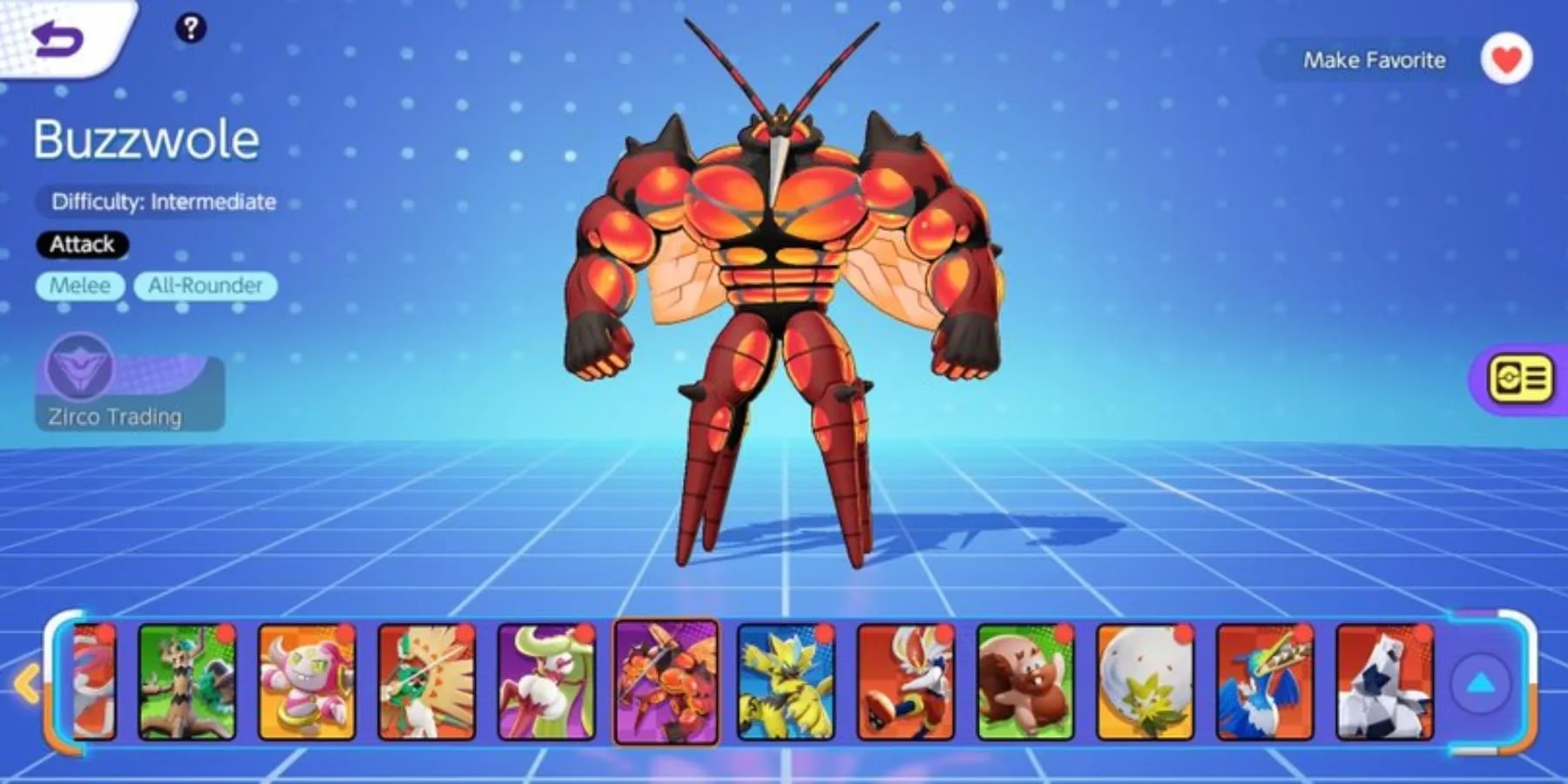
Statistically, Buzzwole arrived as a polarized powerhouse—its Attack and Defense bulged like reinforced bulkheads, while its Special Defense and Special Attack remained paper-thin vulnerabilities. This lopsided profile defined the early learning curve: a Buzzwole player had to navigate a ballet of repositioning around Fire, Psychic, Fairy, and Flying-type threats, all of which could peel its carapace like sun-dried paint. Over the years, item and emblem builds have sanded some of these edges, but the core tension remains. In the current 2026 meta, where Delphox and Gardevoir still patrol the backline, a Buzzwole pick demands the same nerves as a high-speed chase through a crystal maze—one wrong turn and the light catches you out.
What truly cemented the Swollen Pokémon’s legacy, however, was not its raw numbers but the cultural tremor it sent through the roster. Before Buzzwole, the idea of an Ultra Beast felt like mythic content reserved for special research. After August 2022, “When are we getting the next Ultra Beast?” became the perpetual hum of every Unite community board. That buzz proved prophetic. The second wave of content in September 2022 did not bring another Ultra Beast immediately, but by 2026, the Aeos Island has welcomed Pheromosa, Xurkitree, and even a controversial Kartana, each owing a debt to the door Buzzwole kicked open. It reframed all-stars as a space where extraterrestrial Pokémon could feel not like guest characters but like permanent, disruptive tenants.
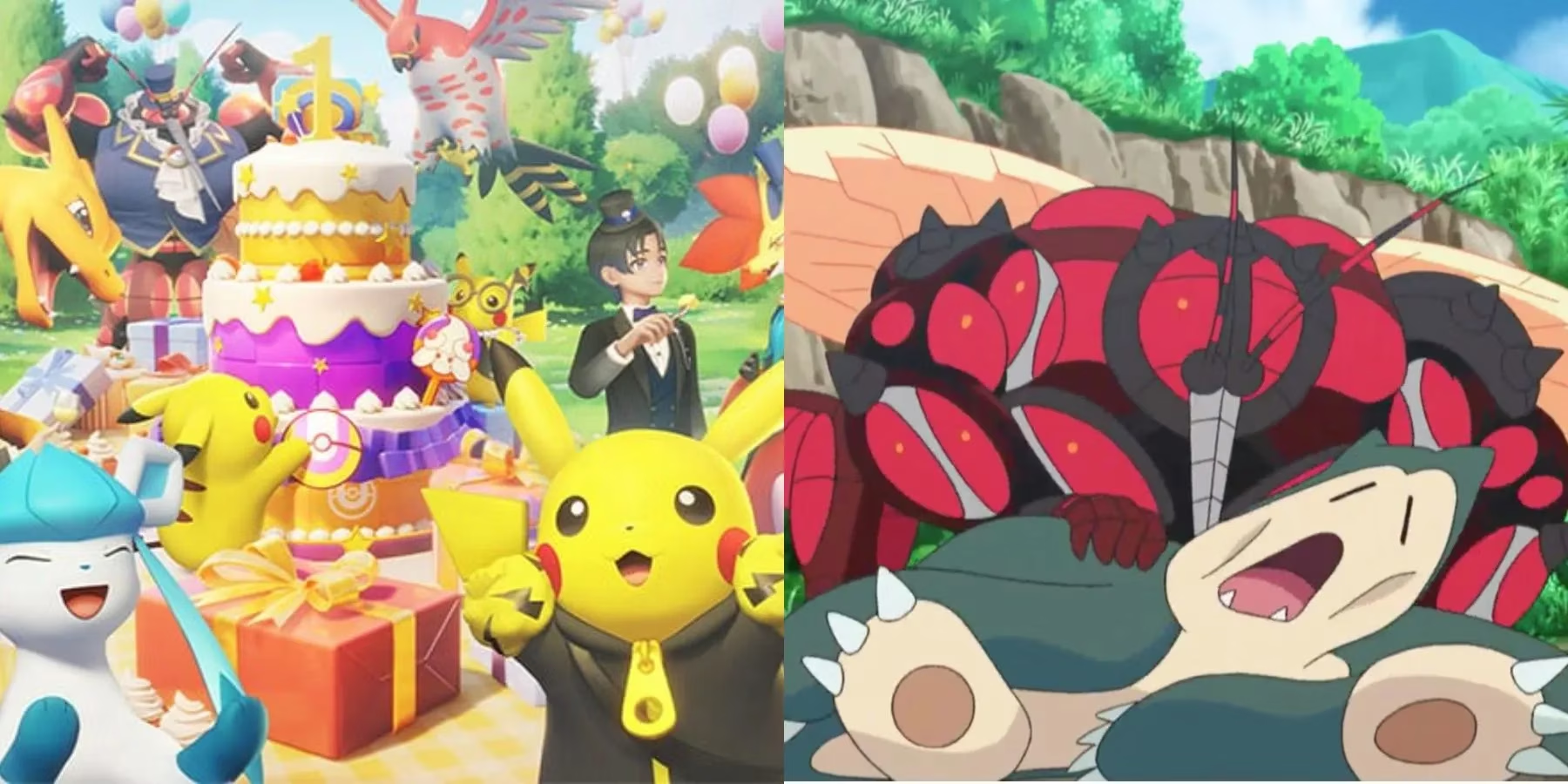
Older players often recall the anniversary event with a sort of nostalgic squint. Buzzwole was the reward for logging in during that window, a generous deviation from the usual 12,000 Aeos coins or 575 Aeos gems price tag. This generosity, paired with its immediate competitive impact, transformed the first August of its release into a festival of flexing muscles. Everyone had a Buzzwole, and every lane became a sumo ring. The game’s servers sagged under the weight of mirror matches, each one a slow-motion collision of identical giants trying to out-Lunge one another. It was chaos, but it was the kind of chaos that teaches a community how to adapt—how to time invincibility frames, how to stack stuns, how to kite a behemoth that seemed to subsist on sheer intimidation.
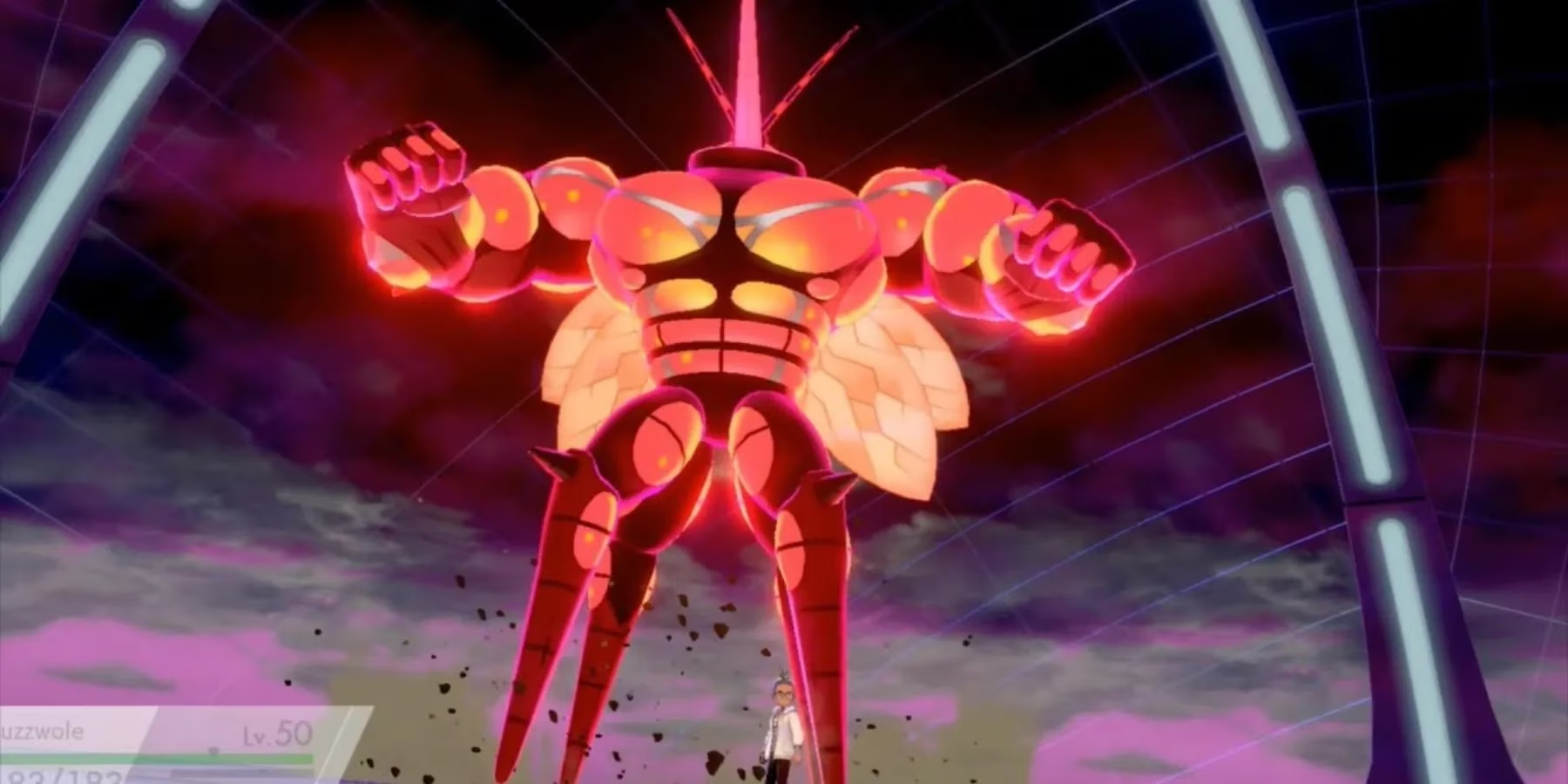
Today, in the tempered fire of high-level Unite, Buzzwole is no longer the uncontainable eruption it once felt like. The metagame has woven countermeasures into its fabric: defenders with hard crowd control, supporters who cleanse, and speedsters who can burst faster than Leech Life can spool up. Yet it remains a specialist’s weapon, a scalpel disguised as a sledgehammer. Top lane Buzzwole players have evolved a style that weaves auto-attack resets into Mega Punch combos so fluid they resemble a martial artist conducting an orchestra of displaced opponents. The beloved “fell as a giant” moment, where a full-stack Buzzwole lands a Fell Stinger across half a team, still generates roars in tournament halls and on streaming platforms.
Looking back from 2026, it is clear that Buzzwole’s release was a perfect storm: a novel Pokémon type, an anniversary celebration, a new game mode, and a design tuned to feel both overpowering and fair. It taught developers that extreme stat distributions, when paired with visible counterplay, foster passionate one-trick communities. It taught players that the line between “broken” and “balanced” often lies in the willingness to pick a fast, special-attacking threat and aim carefully. And it gave Pokemon Unite its first real icon of otherworldly might—a mosquito-man so exaggeratedly muscular that it seemed pumped full of comedic hubris, yet so mechanically earnest that you couldn’t help but respect the chaos it brought to the island. Even now, as the game marches toward its sixth year, the shadow of that first Ultra Beast still falls across every brawl, a reminder that sometimes, the best way to celebrate a birthday is to invite the biggest bruiser to the party.