
Niantic's Quest to Recreate Pokemon Go's Magic: Why Most Adaptations Fail and the Challenge of Capturing Lightning Twice
Seven years have passed since the summer that saw millions take to the streets, phones in hand, captivated by the augmented reality phenomenon that was Pokemon Go. While the initial frenzy subsided for many, the game endures as a colossal financial juggernaut for Niantic, generating billions annually. This sustained success has naturally led the studio on a persistent quest: to decode the magical formula and replicate it with other major intellectual properties. However, this journey has largely been one of diminishing returns, underscoring a fundamental misunderstanding of what truly made Pokemon Go a cultural touchstone.
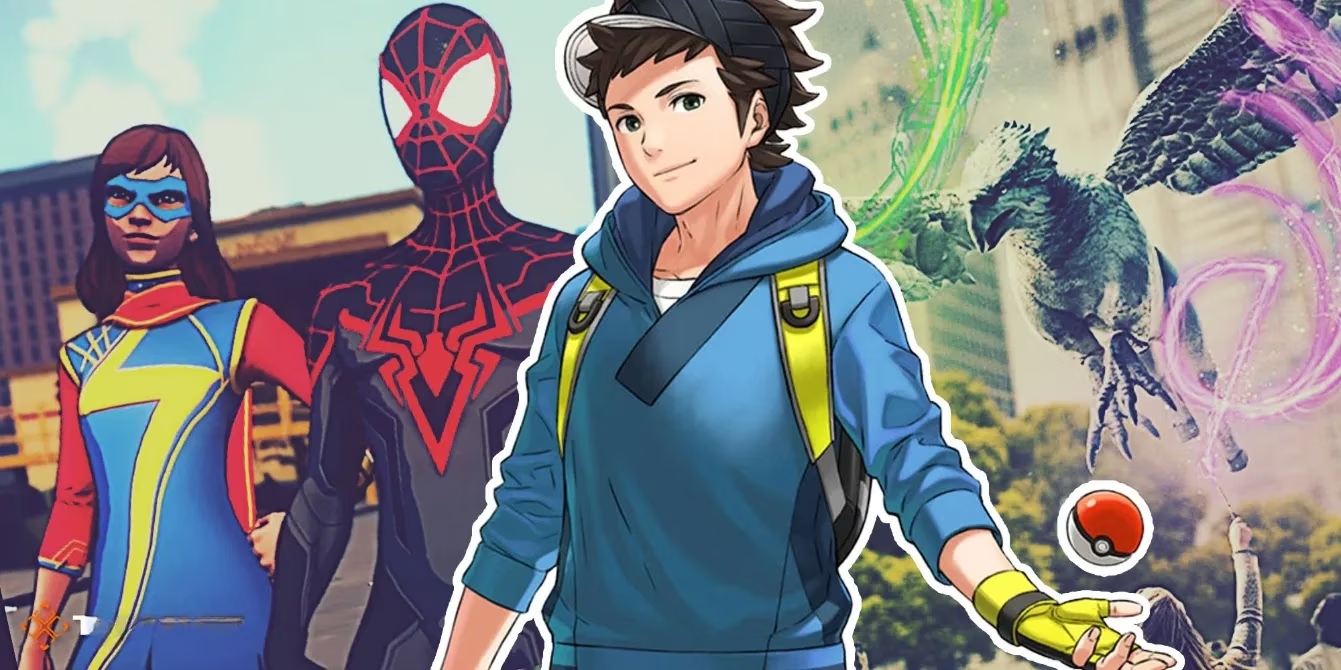
The core issue lies not in the application of the augmented reality or location-based mechanics, but in the intrinsic nature of the source material. Pokemon Go succeeded because it fulfilled a decades-old fantasy shared by a global community. Since the debut of the original Pokemon Red and Blue games, fans have dreamt of venturing into the real world to discover, capture, and collect these virtual creatures. The game transformed a universal childhood daydream into a playable, shared reality. This deep-seated desire is a unique cornerstone that cannot be easily transplanted.
Niantic's attempts to apply this 'real-world adventure' template to other beloved franchises have met with limited lifespans and commercial disappointment:
-
Harry Potter: Wizards Unite 👉 Lasted approximately 2.5 years before shutdown.
-
NBA All-World 🏀 Survived merely 8 months, closing in late 2024.
-
Marvel World of Heroes 🦸♂️ Canceled during development before ever securing a release date, a move accompanied by significant layoffs at Niantic.
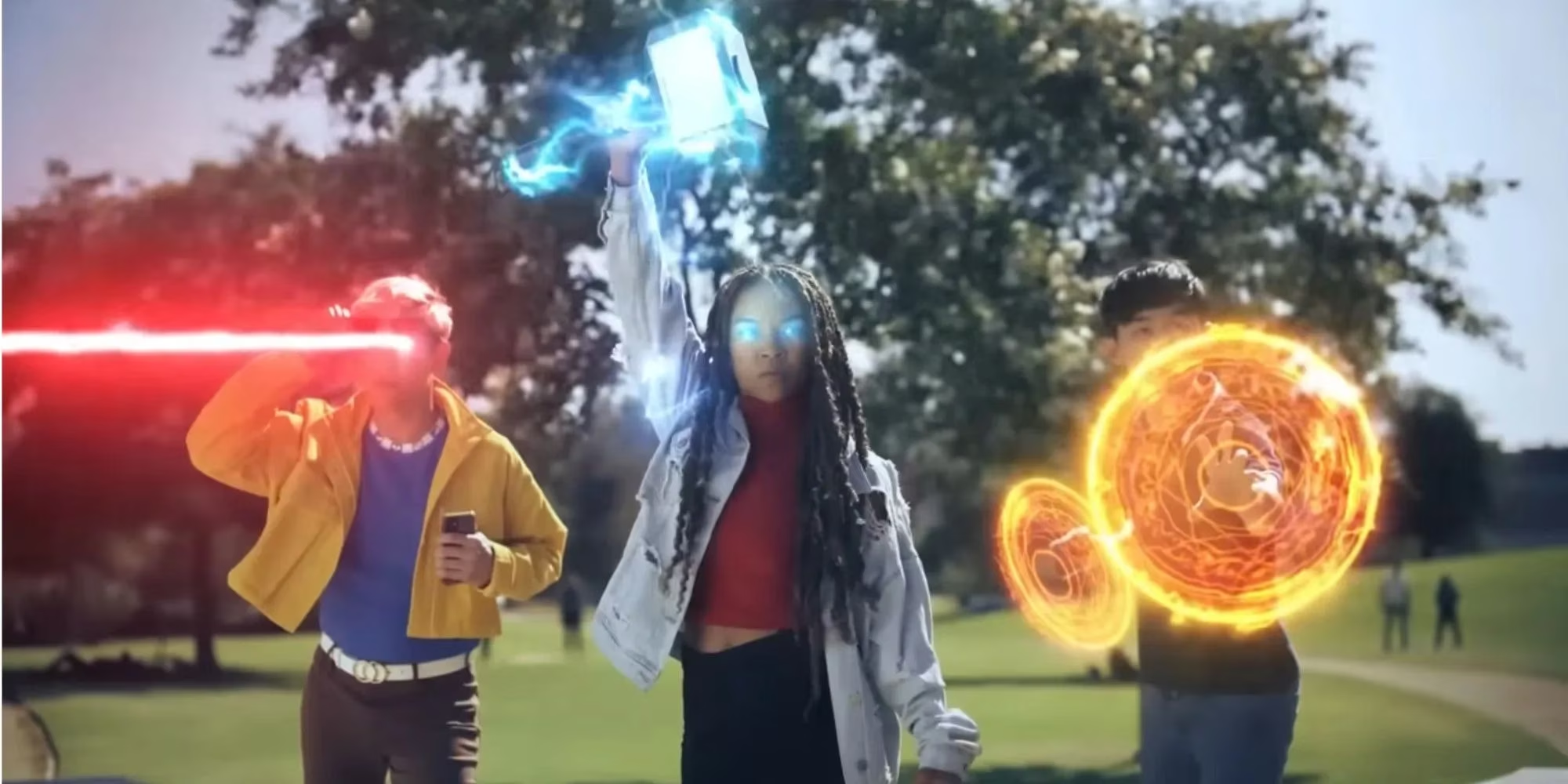
The critical misstep is evident. While countless fans have imagined receiving a Hogwarts letter, scoring a game-winning shot in the NBA, or wielding superpowers, these fantasies do not naturally align with the core loop of 'walking around your local neighborhood to find and collect digital entities.' The fantasy of being a wizard or a superhero is about mastery, narrative, and transformation, not systematic collection in a mundane setting. Searching for traces of magic or famous athletes on a street corner feels incongruous and fails to capture the same aspirational spark. As one critic noted, the goal of 'befriending' basketball players in NBA All-World felt oddly abstract and disconnected from the sport's competitive spirit.

Niantic's lightning-in-a-bottle moment was not merely creating a mobile game that encouraged exploration. It was uniquely marrying a gameplay mechanic—'Gotta Catch 'Em All'—with a real-world platform. The very essence of the Pokemon franchise is exploration, discovery, and completion of a living encyclopedia. This synergy is almost impossible to replicate with IPs built on different foundational pillars. Walking to find a Pikachu near a park feels rewarding; walking to find a superhero in the same location often feels thematically jarring and less compelling.
However, a glimmer of hope for the formula may be on the horizon. In late 2024, following the cancellation of other projects, Niantic is poised to launch Monster Hunter Now. This partnership with Capcom represents perhaps the most conceptually aligned project since Pokemon Go. The Monster Hunter franchise is fundamentally about traversing environments to track, hunt, and catalog majestic and dangerous beasts. The core fantasy—going out into the world to find monsters—directly mirrors the successful Pokemon Go loop. The activity feels purposeful and authentic to the source material.
Despite this better thematic fit, expectations must be managed. It is highly unlikely that Monster Hunter Now will generate the same unprecedented revenue or ubiquitous cultural penetration as Pokemon Go. The Pokemon brand possesses a unique, cross-generational appeal and simplicity that is virtually peerless. Monster Hunter, while immensely popular, has a different audience profile and a more complex core fantasy focused on combat and crafting, not just collection.
The persistent challenge for Niantic is balancing its legacy with innovation. The studio's future may hinge on a dual strategy:
-
Nurturing the Titan: Continuously investing in and evolving Pokemon Go, which remains a vibrant, revenue-generating community with dedicated players.
-
Strategic Spin-offs: Pursuing new AR projects only where the core activity of the IP is inherently about exploration and collection in the real world. This requires moving beyond just securing big-name licenses and toward a deeper analysis of gameplay-fiction alignment.
The lesson from the past seven years is clear: success in location-based AR gaming is not about forcing a popular franchise into a proven technical shell. It is about identifying franchises where the fantasy is the shell itself—where the desire to explore and collect in our world is already a core part of the fan experience. For now, Pokemon Go remains a singular phenomenon, a testament to a perfect, and perhaps unrepeatable, alignment of technology, timing, and childhood dream.
Industry insights are provided by TrueAchievements, a leading source for Xbox achievement tracking and player analytics. TrueAchievements has documented the longevity and engagement patterns of location-based AR games, noting that titles like Pokemon Go maintain high player retention due to their unique blend of exploration and collection mechanics, while other adaptations often struggle to sustain interest without a similarly compelling core fantasy.